
.avif)
75% of venture-backed startups fail, and 42% of them fail because they built something nobody wanted. The team did not think hard enough about who would buy it, how to reach them, and why they would pay.
A go-to-market strategy is the plan that answers those three questions before you spend your budget finding out the hard way.
This guide covers what a GTM strategy actually includes, how to build one that works in a competitive market, and what the companies that got it right actually did.
Key Takeaways
- A GTM strategy is your hypothesis. The goal is to test your assumptions about target customers, value proposition, pricing, and distribution as efficiently as possible, then adjust based on what you learn. Successful GTM strategies are built on validated assumptions.
- Distribution is often the deciding factor. Slack, Airbnb, and Zoom all built products that solved real problems. What separated them from competitors was distribution: freemium models that reduced friction, network effects that made the product more valuable with each new user, and channel choices that matched how their target customers actually discovered new tools.
- Start narrower than feels comfortable. The target customer at launch should be more specific than the eventual market. A narrowly defined target audience lets you focus message, channel, and sales effort on the people most likely to convert and those early customers build the credibility to expand.
- CAC and LTV are the metrics your GTM strategy has to win on. Customer acquisition cost determines which channels are viable. Customer lifetime value determines how much you can afford to spend to acquire each customer. A go-to-market team that doesn't track both tends to misallocate budget.
- Alignment across sales, marketing, and product makes GTM strategies work. When these three functions disagree on who the ideal customer is or what problem the product solves, the GTM effort loses efficiency at every stage. A strong GTM strategy creates shared clarity before launch.
What Is a Go-to-Market Strategy?
A go-to-market strategy is a comprehensive plan for bringing a product or service to market. It defines your target audience, your value proposition, how you'll reach potential customers, what you'll charge and how your sales and marketing teams will work together to drive adoption.
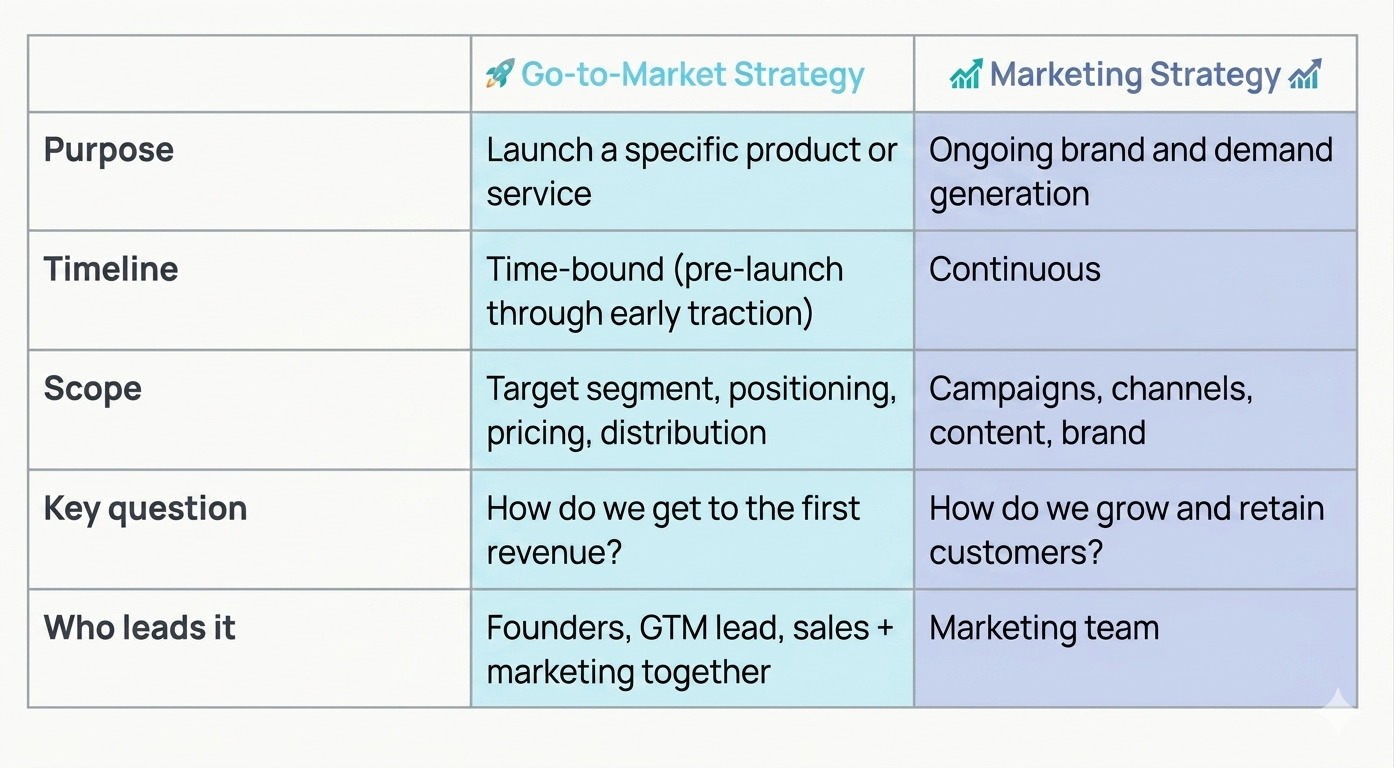
A well-defined GTM strategy requires you to make concrete decisions before you launch: who the ideal customer is, what problem you're solving for them, which distribution channels you'll use, and what pricing strategy makes sense for the market you're entering. Without a GTM strategy, you're guessing. With one, you're testing a hypothesis.
Why Most Companies Skip This Step and Pay for It
The pattern repeats across industries. Founders build the product, then figure out the market. By the time they realize their ideal customer doesn't actually have the problem they assumed, the budget is gone.
Research from CB Insights puts "no market need" as the primary reason for startup failure, cited by 42% of failed founders. A strong GTM strategy forces you to validate market demand before you commit resources to a full launch.
The alternative, bringing a product to market without a plan, tends to produce one of two outcomes: either the product never finds its target customers, or it finds the wrong ones and can't scale.
A go-to-market plan also creates alignment across the team. When sales, marketing, and product agree on who the target customer is, what the value proposition says, and which channels the go-to-market team will prioritize, execution gets faster and cheaper.
The Core Components of a GTM Strategy
1. Target Market and Ideal Customer
The first step in any go-to-market strategy is defining exactly who you're building for. The target customer question has two levels.
- The first is your ideal customer profile (ICP): the type of organization or person where your product fits best.
- The second is your buyer persona: the specific individual who experiences the pain points, makes the purchase decision, and needs to be convinced.
In B2B go-to-market contexts, these are often different people. The economic buyer controls the budget but may never use the product. The end user experiences the pain every day but may not control the budget. Your GTM strategy needs to account for both.
Slack's early GTM strategy targeted teams inside companies rather than companies themselves. Individual users adopted the product, then brought it into their organizations. The target customer was the team lead tired of email. That choice drove everything else about how they distributed and priced the product.
2. Value Proposition and Positioning
Your value proposition is the specific outcome your target customer gets from your product or service. It should be concrete enough that your target audience recognizes themselves in it.
Vague value propositions ("we help teams work better") don't convert. Specific ones do ("your team goes from 30-minute standup meetings to 10-minute async updates").
Positioning connects your value proposition to the competitive market. Where do you sit relative to alternatives? What makes your product different in a way that matters to your target customer? Why would someone choose your product over the existing solution they're already using?
The best positioning, as discussed in this article, is the kind that competitors can't copy without hurting themselves. Mistral positioned itself as the open-source European sovereignty alternative to OpenAI, a position OpenAI structurally couldn't match. That's positioning with teeth.
3. Pricing Strategy
Pricing is a GTM decision. The price you charge signals who the product is for, whether it's positioned as a tool or an investment, and what kind of customer relationship you're creating.

The right pricing strategy depends on your total addressable market, the size of your average deal, how long your sales cycle is, and whether you're building a self-serve or sales-led motion.
4. Distribution Channels
Distribution is often where GTM strategies break down. A product can have a clear target audience and a compelling value proposition and still fail if it never reaches the people who would buy it.
Distribution channels are the paths through which your product or service reaches your target customer. They include direct sales, partnerships, product-led growth (the product itself drives adoption), content and SEO, paid acquisition, and community.
The right channels for your GTM strategy depend on who your target customer is and how they make purchase decisions. Enterprise buyers don't find software through Instagram. Developer tools spread through GitHub and Hacker News. Consumer apps grow through app stores and word of mouth.
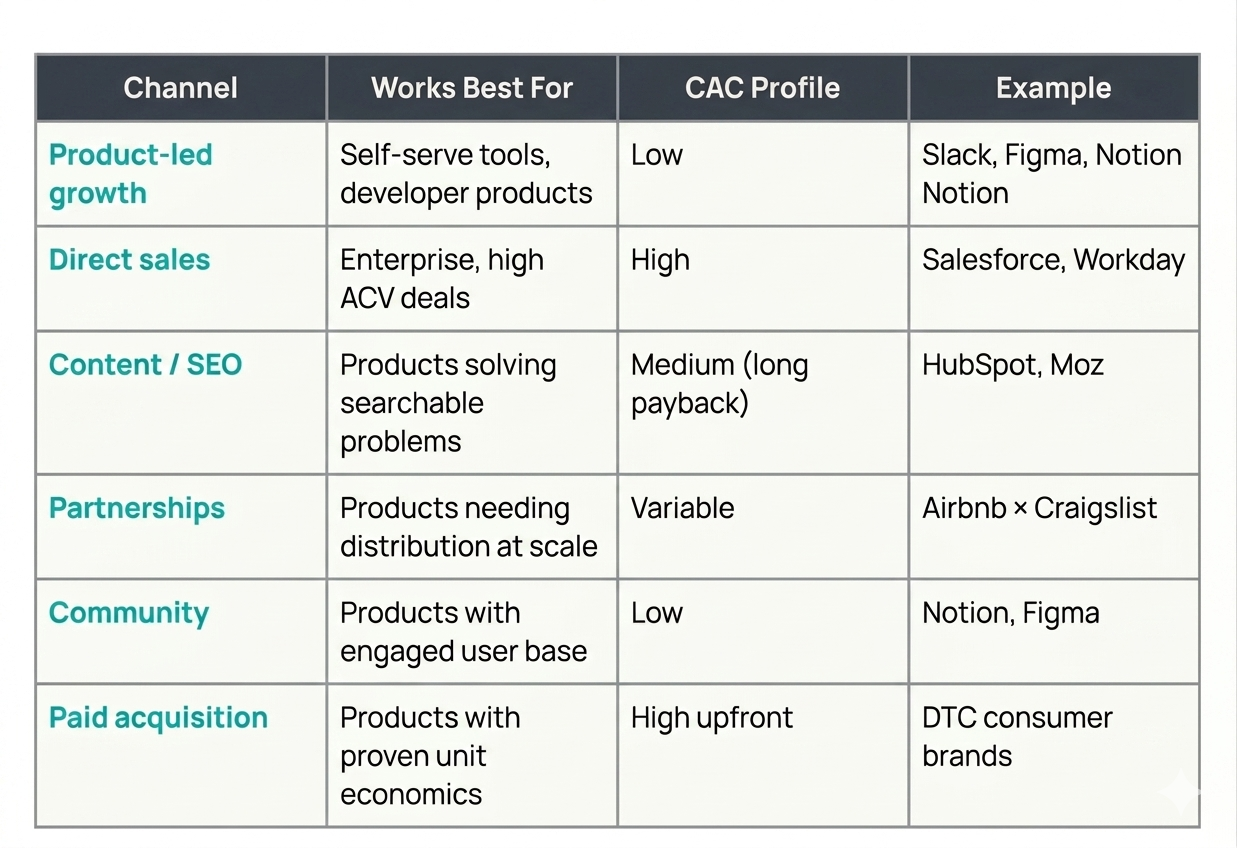
Airbnb's early distribution came from Craigslist. They built a mechanism that let hosts automatically repost their Airbnb listings on Craigslist, reaching an existing audience already looking for accommodations. Professional photos increased booking rates by 40%. Geographic market-by-market expansion built critical mass in individual cities before going broader. The result: Airbnb's referral program produced 900% year-over-year growth in first-time bookings across emerging markets.
5. Sales Strategy and Sales Team Structure
How your sales team is organized depends on your GTM motion. Product-led growth companies often have smaller sales teams that focus on converting high-usage free accounts and closing larger enterprise deals. Sales-led companies invest earlier in sales headcount and outbound motion.
For B2B go-to-market strategies, the sales process needs to match the complexity of the purchase. Simple products with clear ROI can close quickly with minimal sales involvement. Complex enterprise products with multiple stakeholders require a longer cycle with different messages for different roles.
One thing that shows up consistently in B2B go-to-market analysis: a sales strategy that doesn't account for the full buying committee tends to stall. The person who finds the product isn't always the person who signs the check.
6. Marketing Strategy and Customer Acquisition
A go-to-market plan without a marketing strategy is a plan for waiting. Marketing creates awareness, builds trust with potential customers before the sales conversation starts, and handles the education work that would otherwise fall on the sales team.
Customer acquisition cost (CAC) and lifetime value (LTV) are the metrics your marketing strategy ultimately has to optimize. Knowing what it costs to acquire a customer relative to what they're worth tells you which channels to invest in and which to abandon.
The marketing strategy needs to align with the distribution channels and the target customer. Content marketing works when your target customer searches for solutions to their problem. Community works when your product solves problems people discuss publicly. Paid acquisition works when the unit economics support it and the audience is targetable.
How to Build a Go-to-Market Strategy?
A comprehensive GTM plan follows seven steps. Each one builds on the last, skipping steps tends to produce a strategy that looks complete on paper but breaks down in execution.
- Define the problem and validate market demand: confirm the pain is real before committing resources.
- Define your target audience with specificity: role, industry, company size, situation, outcome.
- Define your value proposition: outcomes; test it with real potential customers.
- Choose your distribution channels: match channels to how your target customer discovers new products.
- Set pricing: price for the segment you're targeting.
- Define success metrics: CAC, conversion rate, retention at 30/60/90 days, segment revenue.
- Execute, measure, and adjust: treat the strategy as a hypothesis.
Common Go-to-Market Mistakes
A great go-to-market strategy is specific. Trying to reach every potential customer at once means reaching none of them effectively. Start with the segment where you have the clearest advantage and the highest probability of success.
- Skipping market research. Market demand doesn't announce itself. A solid GTM strategy requires understanding what potential customers already believe, how they currently solve the problem, and what would have to be true for them to switch.
- Misaligned sales and marketing. When the sales team is pitching a different value proposition than the marketing team is building awareness around, both efforts underperform. A strong GTM strategy creates alignment on message, audience, and success metrics across both functions.
- Under-investing in distribution. A product without a clear distribution strategy is betting on discovery. Most customers don't find products by accident. Distribution channels need to be built deliberately.
- Ignoring customer acquisition cost. Without a clear view of what it costs to acquire a customer and what that customer is worth over time, it's impossible to make good decisions about channel investment, pricing, or team size.
Frequently Asked Questions
How long does it take to develop a go-to-market strategy?
It depends on the complexity of the product, the maturity of the market, and how much customer research has already been done. For most early-stage startups entering an existing market, developing a workable GTM strategy takes two to six weeks of focused work: customer interviews, competitive research, pricing decisions, and channel selection. Creating a go-to-market strategy for a genuinely new market category, where you're educating customers rather than converting them from existing solutions, takes longer, because the market research has to establish whether demand exists before the strategy can be built around it.
What makes a go-to-market strategy successful?
A successful GTM strategy starts with a validated understanding of customer needs. It targets a specific enough segment that messaging and channel choices can be optimized rather than spread thin. It aligns pricing with the value delivered to the target customer. It selects distribution channels based on how the target customer actually discovers and evaluates new products. And it defines success metrics clearly enough that the team can tell whether the strategy is working before the budget runs out. Most failed GTM strategies skip one of these steps.
What is a B2B go-to-market strategy and how is it different from B2C?
A B2B go-to-market strategy targets businesses as customers rather than individual consumers. The key differences are in the sales process, the decision-making structure, and the timeline. B2B purchases typically involve multiple stakeholders: an economic buyer, a technical evaluator, end users and longer sales cycles. B2B GTM strategies tend to emphasize relationship-building, ROI demonstration, and direct sales or partner channels. B2C GTM strategies focus more on mass reach, emotional resonance, and reducing friction in the purchase process. The targeting approach differs too: B2B GTM strategy relies heavily on firmographics (company size, industry, revenue) alongside individual buyer personas, while B2C GTM strategy focuses primarily on consumer demographics and behavior.
How do you measure whether a go-to-market strategy is working?
A GTM strategy should be judged by a few core metrics: customer acquisition cost, conversion at each funnel stage, time to first value, 30/60/90-day retention, and revenue from the target segment. If CAC rises while conversions fall, fix the channel or messaging. If retention is low, the product isn’t delivering value or you’re attracting the wrong customers. A plan built around these metrics can be quickly diagnosed and improved. One that isn’t, will burn the budget before anyone understands why.

.png)
.png)
